
How Many Fire Extinguishers Does an Office Need? Types, Placement & Safety Guide
Discover how many fire extinguishers an office needs in Nepal. Learn about suitable extinguisher types, quantity, placement, and fire safety considerations for workspaces, server rooms, electrical rooms, and office pantries.
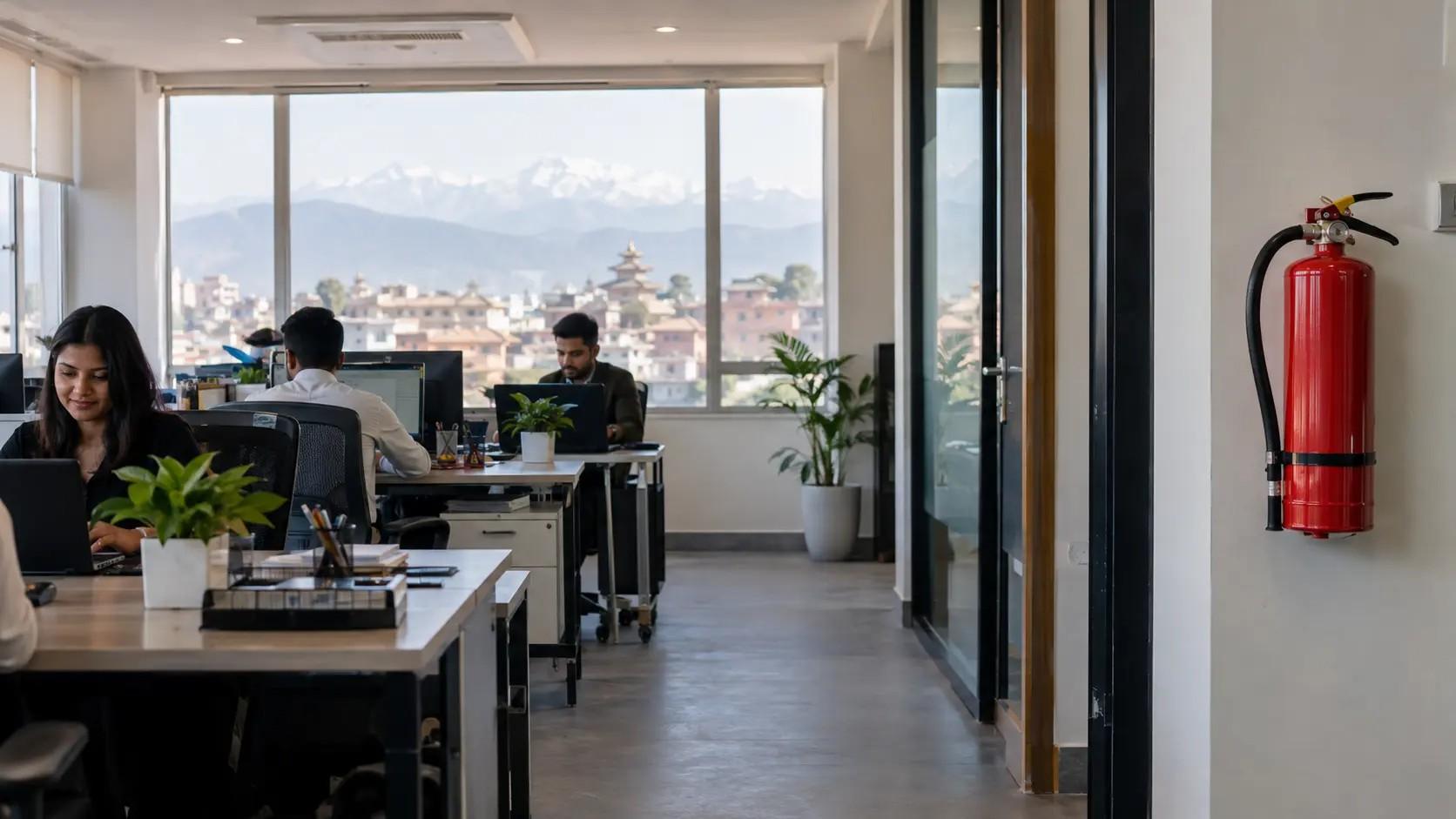
ire extinguishers are an essential part of office fire safety, but simply placing one extinguisher somewhere near the entrance does not necessarily provide adequate protection.
Modern offices contain several different fire hazards. Paper, furniture and documents create ordinary combustible risks, while computers, UPS systems, electrical panels, servers and office appliances introduce electrical hazards. Larger offices may also have kitchens, document archives, storage rooms, server rooms and multiple floors that require separate consideration.
This is why the answer to “How many fire extinguishers does an office need?” cannot be reduced to one universal number.
The correct quantity depends on factors such as:
office floor area
number of floors
building layout
fire hazards present
extinguisher fire rating
travel distance to an extinguisher
server and electrical rooms
kitchens or pantries
document and storage areas
accessibility during an emergency
Office owners and facility managers should therefore determine extinguisher quantity together with type and placement, rather than purchasing a fixed number of identical cylinders.
For broader commercial fire-protection planning, see Safelinc's fire extinguisher range in Nepal.
What Fire Risks Are Common in Offices?
An office may appear to be a relatively low-risk environment, but a typical workspace contains both combustible materials and energized electrical equipment.
The level of risk also changes from one part of the office to another.
Office area | Typical fire hazards | Main extinguisher consideration |
General workspace | Paper, furniture, plastics, electrical devices | General combustible + electrical risk |
Reception | Furniture, paper, computers, displays | General coverage |
Server room | Servers, UPS, networking equipment | Electrical suitability and minimal residue |
Electrical room | Distribution panels, breakers, wiring | Electrical equipment protection |
Pantry | Electrical appliances, LPG or cooking equipment where present | Appliance/cooking hazard |
Archive room | Paper files, documents, shelving | Higher combustible fire load |
Store room | Packaging, stationery, cleaning materials | Stored-material fire load |
Meeting rooms | Furniture, electronics, AV equipment | General + electrical hazards |
Printing area | Printers, copiers, paper | Electrical + combustible materials |
Because these hazards are different, the best office fire-extinguisher arrangement may involve more than one extinguisher type.
Safelincs' current fire-extinguisher guidance also identifies offices as environments containing paper, furniture, computers and electrical equipment, where both fire rating and electrical suitability need to be considered.
How Many Fire Extinguishers Does an Office Need?
There is no single number that can safely be applied to every office. For example, a small single-floor office, a three-storey corporate building and a large open-plan call centre may all require very different extinguisher quantities even if they employ a similar number of people.
A proper calculation should consider the following factors:
1. Office Floor Area
The total area requiring protection is one of the first considerations. As office size increases, more extinguisher coverage may be required to ensure that employees do not have to travel an excessive distance to reach suitable equipment.
However, square metres alone should not determine the quantity. Two offices with the same floor area may have completely different hazards because one may contain only general workstations while another includes:
a server room
a large archive
an electrical control room
a pantry
storage areas
high concentrations of electronic equipment
2. Number of Floors
Each office floor needs to be assessed according to its own layout and fire hazards. An extinguisher positioned on the ground floor should not automatically be treated as adequate protection for employees working on upper floors.
For a multi-storey office, consider separately: Floor Area → Fire Hazards → Escape Routes → Travel Distance → Extinguisher Rating → Quantity
This provides a much stronger approach than simply multiplying the same number of extinguishers across every floor.
3. Fire Rating of the Extinguisher
Cylinder capacity and fire rating are not the same thing. An extinguisher's fire rating indicates its tested firefighting capability for the fire classes for which it is certified. Therefore, determining office coverage should consider the actual fire rating of the selected extinguisher rather than only whether it is labelled 2 kg, 4 kg, 6 kg or 9 kg.
Safelincs' technical guidance similarly recommends evaluating extinguisher type, fire rating, capacity, discharge characteristics and application rather than selecting equipment based only on cylinder size.
4. Travel Distance and Accessibility
Employees need to be able to reach the correct extinguisher quickly and safely. Long corridors, partitions, locked rooms, staircases, enclosed departments and complex office layouts can all affect accessibility.
Even when the total floor area seems small, additional extinguishers may be necessary if the layout prevents safe and convenient access.
5. Fire Hazard
Higher-risk rooms often need their own protection. A general ABC extinguisher positioned in a corridor may contribute to overall coverage, but a server room or electrical room may require an extinguisher specifically selected for sensitive energized equipment.
Similarly, an office pantry with significant cooking equipment should be assessed separately.
6. Building Layout
Office design can significantly change extinguisher requirements. Important considerations include:
open-plan versus partitioned offices
number of exits
corridor length
enclosed rooms
staircases
separate departments
restricted-access spaces
multiple buildings or office blocks
A Better Method for Determining Quantity
Instead of asking only: “How many extinguishers should we buy?”
Use: Site Survey → Identify Hazards → Determine Fire Classes → Select Extinguisher Type & Rating → Assess Floor Coverage → Check Travel Distance → Identify Special-Risk Areas → Determine Quantity → Finalize Placement
This produces an extinguisher plan based on the actual office rather than an arbitrary number.
Nepal's Department of Urban Development and Building Construction currently lists NBC 107: Provisional Recommendation on Fire Safety within the Nepal National Building Code resources. NBC 107 describes commercial and office buildings under ordinary buildings, while also making clear that its provisions are fundamental requirements and that additional relevant standards may be necessary depending on the building.
For that reason, office owners should avoid treating a single generic extinguisher quantity as a universal Nepal-wide rule.
Which Fire Extinguisher Is Best for an Office?
Most offices contain more than one fire hazard, so extinguisher selection should begin with the materials and equipment present.
Two extinguisher technologies are particularly relevant to many office environments: ABC Dry Powder + CO₂
Some offices containing particularly valuable or sensitive electronics may also consider clean-agent extinguishers.
ABC Fire Extinguishers for Offices
ABC dry-powder extinguishers are widely used for general fire protection because appropriately rated units can cover several common fire hazards.
In an office, these may include combustible materials such as:
paper;
cardboard;
furniture;
documents;
fabrics; and
some mixed general hazards.
This makes ABC extinguishers suitable for consideration in general office areas, corridors, reception areas, storage areas and similar locations depending on the specific product rating.
Safelincs currently provides multiple capacities of ABC type fire extinguishers for commercial applications.
Advantages of ABC Extinguishers in Offices
ABC extinguishers provide broad multipurpose protection and are available in different capacities and fire ratings. However, dry powder leaves residue after discharge.
This becomes an important consideration around expensive electronics, servers and other sensitive equipment.
CO₂ Fire Extinguishers for Offices
CO₂ extinguishers are particularly relevant to areas containing energized electrical or electronic equipment.
Typical office applications may include:
computer rooms;
electrical panels;
UPS systems;
server equipment;
networking equipment;
photocopiers;
communications equipment; and
electrical control systems.
One major advantage is that CO₂ does not leave the dry chemical residue associated with ABC powder.
Safelinc’s CO₂ fire extinguisher range includes portable units intended for appropriate electrical and flammable-liquid applications. CO₂ should still be selected according to the actual fire hazard, certified rating, room conditions and manufacturer instructions. It should not be treated as a universal substitute for general combustible-fire protection.
ABC vs CO₂ Fire Extinguishers for Offices
A common question is whether an office should install ABC or CO₂ extinguishers. In many offices, the practical answer is not necessarily ABC versus CO₂, but rather ABC together with CO₂ where the hazards justify both.
Factor | ABC Dry Powder | CO₂ |
General office combustibles | Often suitable when correctly rated | Not normally the primary choice |
Electrical equipment | May be rated for appropriate electrical hazards | Commonly selected |
Residue after discharge | Yes | Virtually no solid residue |
Sensitive electronics | Residue can create cleanup concerns | Often preferable where suitable |
Server/network room | Possible depending on rating but residue is a concern | Frequently considered |
General corridor coverage | Common application | Usually supplementary where electrical risks exist |
The selection should always follow the fire rating and manufacturer instructions of the actual extinguisher.
Fire Extinguisher for Server Rooms
Server rooms require more careful extinguisher selection than general office areas. The room may contain:
Servers + Network Switches + UPS Systems + Batteries + Power Supplies + Cabling + Cooling Equipment
Even a relatively small fire can cause substantial equipment loss and business interruption. Dry powder can extinguish appropriate fires effectively, but the residue left behind may create additional cleanup and equipment-damage concerns.
For this reason, suitable CO₂ or clean-agent protection may be considered for sensitive server and IT environments.
Safelincs provides clean-agent fire extinguishers intended to minimize extinguishing residue and lists applications involving sensitive electrical and electronic equipment.
Server Room Placement
The extinguisher should generally be positioned so that staff can access it without having to move deeper into a developing fire. Placing the only extinguisher behind server racks or directly beside the most likely ignition source can make it inaccessible during an emergency.
Server-room protection should also be coordinated with:
smoke or appropriate fire detection
alarm notification
electrical isolation
cable management
UPS/battery safety
cooling-system maintenance
emergency procedures
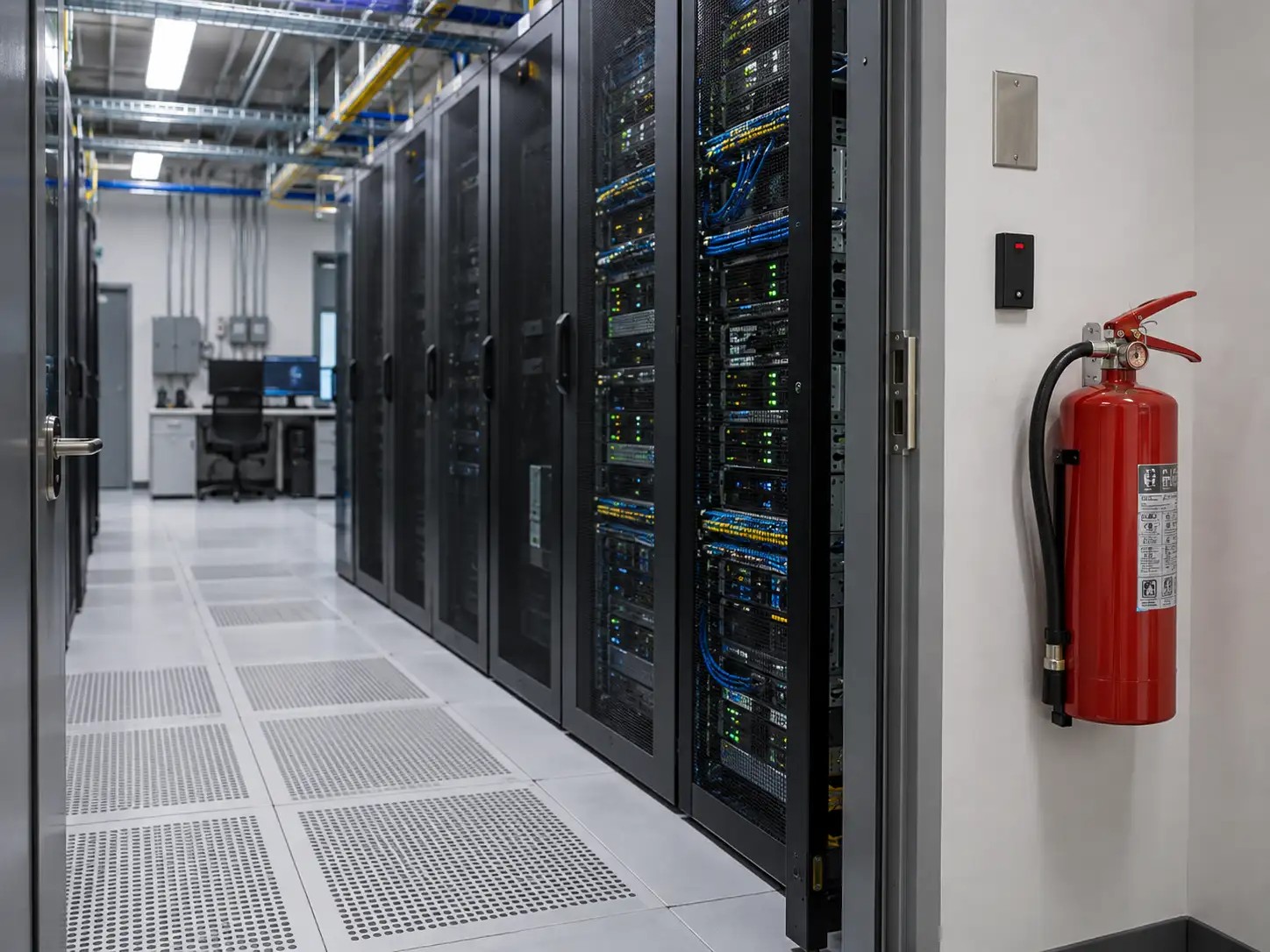
Fire Extinguishers for Electrical Panels and Electrical Rooms
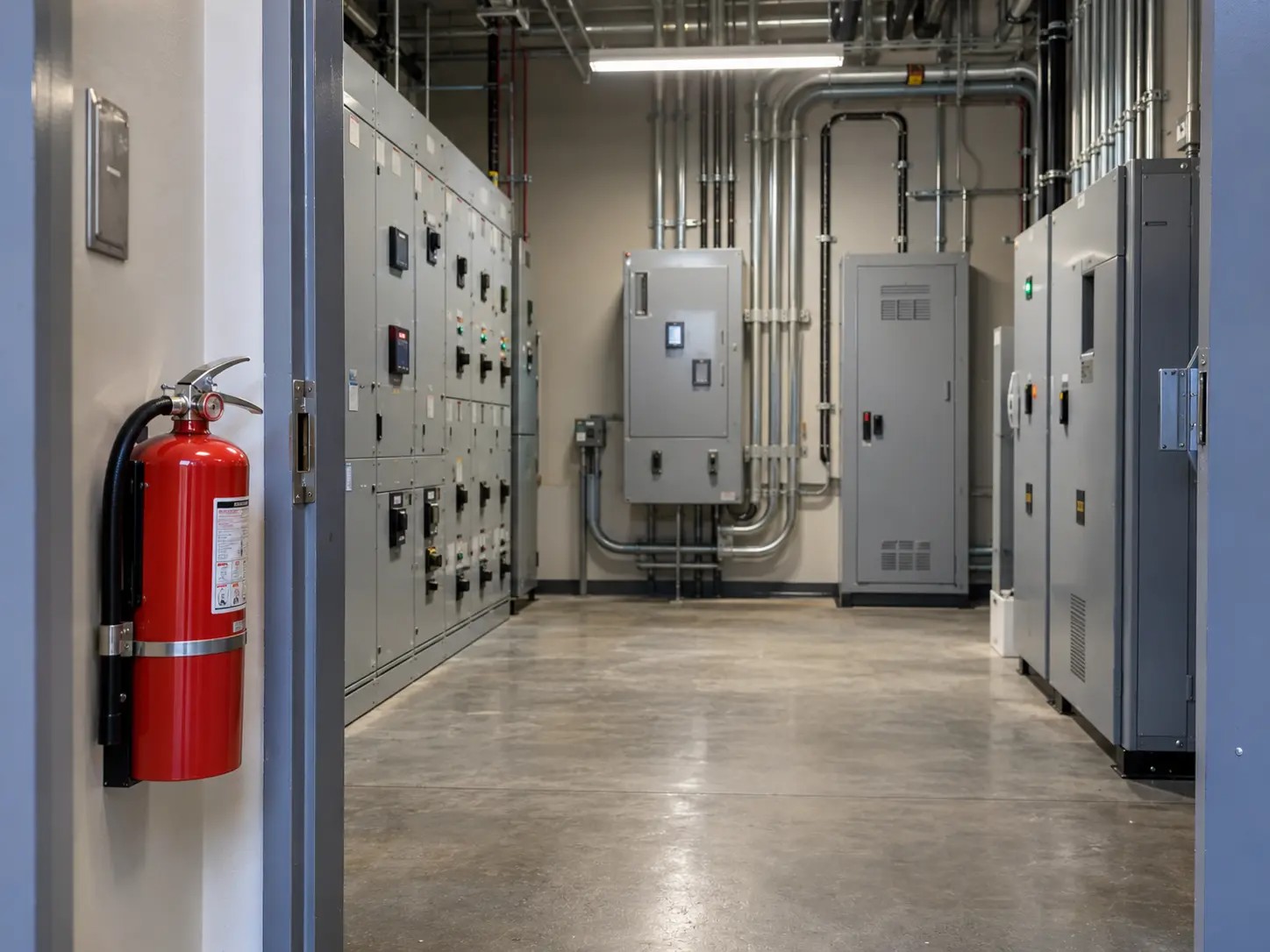
Electrical distribution boards and control panels introduce another distinct office hazard. An electrical-room extinguisher should be:
suitable for the identified electrical hazard
accessible without approaching the energized equipment unnecessarily
clearly visible
unobstructed
positioned where the developing fire is unlikely to block access
CO₂ may be considered for suitable electrical equipment because of its electrical application and lack of powder residue. If the electrical room also contains combustible storage, additional hazards should be assessed separately.
An electrical room should not become a general storage room simply because unused space is available.
Fire Extinguishers for Office Pantries
A small office pantry and a commercial kitchen should not automatically receive the same extinguisher specification. A simple pantry may contain:
kettle
microwave
refrigerator
coffee machine
toaster
electrical outlets
These primarily create electrical and ordinary combustible risks.
However, some larger offices operate staff kitchens containing gas burners, LPG, frying equipment or significant amounts of cooking oil. Those areas require a separate kitchen fire-risk assessment.
Where high-temperature cooking oils and fats are used, specialist kitchen extinguishing equipment may be necessary rather than relying only on the general office extinguisher.
Fire Extinguishers for Document and Archive Rooms
Document storage areas can create a substantial Class A combustible fire load because they may contain large quantities of:
paper
files
cardboard boxes
shelving
packaging
stored office supplies
An archive room should therefore be assessed according to the amount and density of combustible material, not simply its floor dimensions. Large document stores may require a different protection strategy from ordinary workstations.
Good housekeeping is equally important. Unnecessary paper accumulation, blocked aisles and storage close to electrical equipment can increase fire risk and make emergency response more difficult.
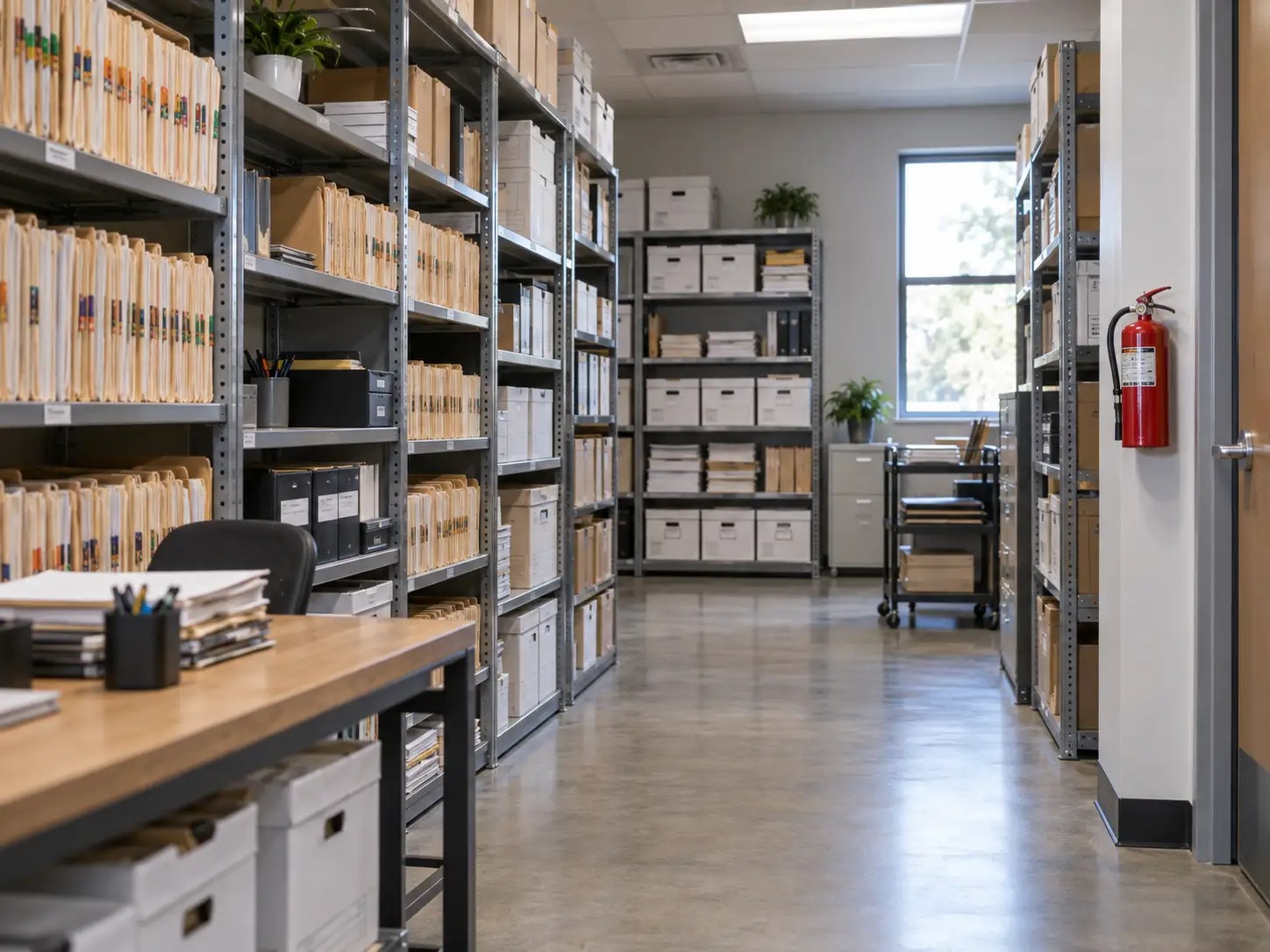
Office Fire Extinguisher Placement
Correct extinguisher placement is just as important as choosing the extinguisher itself.
Safelincs' current technical guidance recommends that extinguishers remain visible, accessible, properly mounted or secured, unobstructed and positioned according to the identified hazard. It also notes that an extinguisher should not be located where the developing fire itself could prevent safe access.
Typical office locations to assess include:
corridors
escape routes
stairways
reception/common areas
near higher-risk rooms
outside or appropriately near server rooms
electrical-room access points
archive/storage areas
pantry/kitchen areas
The aim is not to scatter extinguishers randomly around the office. Placement should provide logical, visible and safe access while maintaining an escape route.
Avoid Poor Placement
An extinguisher may provide little practical value if it is:
hidden behind furniture;
inside a locked cupboard;
blocked by stored boxes;
concealed behind a door;
placed directly beside the likely fire source;
installed where employees cannot see it; or
positioned far from the area it is intended to protect.
Proper fire-extinguisher signage can also help identify equipment quickly.
Multi-Storey Office Fire Extinguisher Requirements
Multi-storey offices need additional planning because occupants cannot reasonably depend on equipment installed on another level. Each floor should be evaluated separately according to:
Floor Area + Fire Load + Layout + Fire Rating + Travel Distance + Special Hazards
For example, the fourth floor may contain only workstations, while the second floor contains a server room and archive storage.
Providing exactly the same equipment on both floors without assessing the different hazards may not represent the best protection strategy. Multi-storey office planning should also consider:
protected escape routes
staircases
emergency exits
fire detection
manual call points
audible/visual alarms where appropriate
emergency lighting
compartmentation
firefighting access
Portable extinguishers are only one layer of the overall fire-safety system.
Fire Extinguishers Should Work With the Office Fire Alarm System
Fire extinguishers are designed for initial fire suppression. They should not replace early detection and occupant warning. A more complete office fire-safety strategy follows:
Detection → Alarm → Occupant Warning → Initial Suppression → Evacuation → Firefighting Response
Depending on the building size and design, an office fire-alarm system may include:
fire alarm control panel
smoke detectors
heat detectors
manual call points
sounders
strobes
interface modules
standby batteries
fire-resistant cabling
Safelincs supplies both conventional and addressable fire alarm systems in Nepal for office, commercial and institutional applications. For broader planning, explore Safelincs' complete fire safety equipment and products.
Office Fire Extinguisher Inspection and Maintenance Checklist
Installing extinguishers is only the beginning. They must remain available and serviceable throughout their operating life. Office facility managers should routinely check:
extinguisher is in its designated location
access is unobstructed
operating instructions are readable
safety pin is present
tamper seal is intact
hose or nozzle is undamaged
cylinder shows no significant corrosion or physical damage
pressure indicator is within its normal operating range where fitted
bracket or stand is secure
signage remains visible
extinguisher has not been discharged
servicing records are current
staff know the emergency procedure
Any extinguisher that has been discharged, even partially, should be inspected and serviced before being relied upon again.
Staff Fire-Extinguisher Training
Employees should understand that fire extinguishers are intended for small, early-stage fires when conditions remain safe. Personnel expected to use extinguishers should understand:
P: Pull the pin
A: Aim at the base of the fire
S: Squeeze the operating handle
S: Sweep from side to side
Safelincs has a detailed PASS Method fire-extinguisher guide covering pre-use checks, extinguisher selection and safe operating technique. Employees should never continue attempting to fight a fire if:
it is spreading rapidly
smoke is reducing visibility
the extinguisher is ineffective
the correct extinguisher is unavailable
the person's escape route is threatened
conditions are otherwise unsafe
Life safety and evacuation take priority.
Office Fire Safety Checklist
Before finalizing office fire-extinguisher protection, check:
All office floors have been assessed separately
General combustible fire hazards have been identified
Computers and electrical equipment have been considered
Server/IT rooms have dedicated assessment
Electrical rooms and distribution panels are protected appropriately
Pantry or kitchen hazards have been assessed
Archive and document-storage fire load has been considered
Correct extinguisher types have been selected
Fire ratings have been reviewed
Quantity is based on area, hazard, layout and accessibility
Travel distance has been considered
Extinguishers are visible and unobstructed
Escape routes remain clear
Fire-alarm and detection systems are operational
Extinguishers are inspected and maintained
Staff receive appropriate fire-safety instruction
Emergency and evacuation procedures are documented
Choosing Fire Extinguishers for Your Office in Nepal
The most important point is that office fire-extinguisher quantity should not be decided by office size alone.
A suitable design considers: Office Area + Number of Floors + Fire Load + Fire Rating + Electrical Risk + Special Rooms + Travel Distance + Building Layout
A typical office may use appropriately rated ABC extinguishers for broader general risks while providing CO₂ or clean-agent protection where sensitive electrical equipment creates a specific hazard. Larger offices may also require a coordinated system including fire detection, alarm notification, emergency exits, hydrant or firefighting systems and other fire-safety equipment.
Safelincs Technologies supplies fire extinguishers in Nepal together with fire alarm, detection and wider fire-safety solutions for offices and commercial properties.
For projects where the correct quantity is uncertain, the extinguisher schedule should be finalized after evaluating the building layout and actual fire hazards rather than simply purchasing an arbitrary number of cylinders.
Frequently Asked Questions
1. How many fire extinguishers does an office need?
There is no single number suitable for every office. Quantity should be determined from floor area, number of floors, fire rating, travel distance, layout and specific hazards such as server rooms, electrical rooms and kitchens.
2. Which fire extinguisher is best for an office?
Appropriately rated ABC extinguishers are commonly considered for general office hazards, while CO₂ may be suitable for electrical and electronic equipment. Some offices may therefore require both rather than relying on one extinguisher type.
3. Do offices need a CO₂ fire extinguisher?
A CO₂ extinguisher may be appropriate where energized electrical equipment, server equipment, UPS systems or electrical panels create a significant hazard. The final selection should follow the actual fire risk and product rating.
4. Where should fire extinguishers be placed in an office?
They should be visible, unobstructed and safely accessible along appropriate circulation or escape routes and near identified higher-risk areas. An extinguisher should not be positioned where the developing fire is likely to block access.
5. Does a server room need a separate fire extinguisher?
Server rooms should be assessed separately because they contain sensitive energized electronic equipment. CO₂ or an appropriately rated clean-agent extinguisher may be considered depending on the equipment, room conditions and site fire-risk assessment.
6. Can ABC extinguishers be used around computers?
Some ABC extinguishers may be rated for relevant electrical hazards, but dry chemical powder leaves residue after discharge. For sensitive or high-value electronic equipment, residue considerations may make CO₂ or suitable clean-agent protection preferable.
7. Does every office floor need fire extinguishers?
Every floor should be assessed independently for fire risks, area, layout, accessibility and travel distance. Equipment on another floor should not automatically be counted as practical protection for the occupied floor.
8. Are fire extinguishers enough for office fire safety?
No. Portable extinguishers are one element of a wider system that may also include smoke or heat detection, fire alarms, manual call points, emergency exits, evacuation procedures and other firefighting equipment.