
Fire Extinguisher Requirements for Shopping Malls & Retail Stores: Quantity, Types & Placement
Explore fire extinguisher requirements for shopping malls and retail stores in Nepal, including suitable types, quantity, placement, and fire safety considerations for retail shops, food courts, storage rooms, and parking areas.
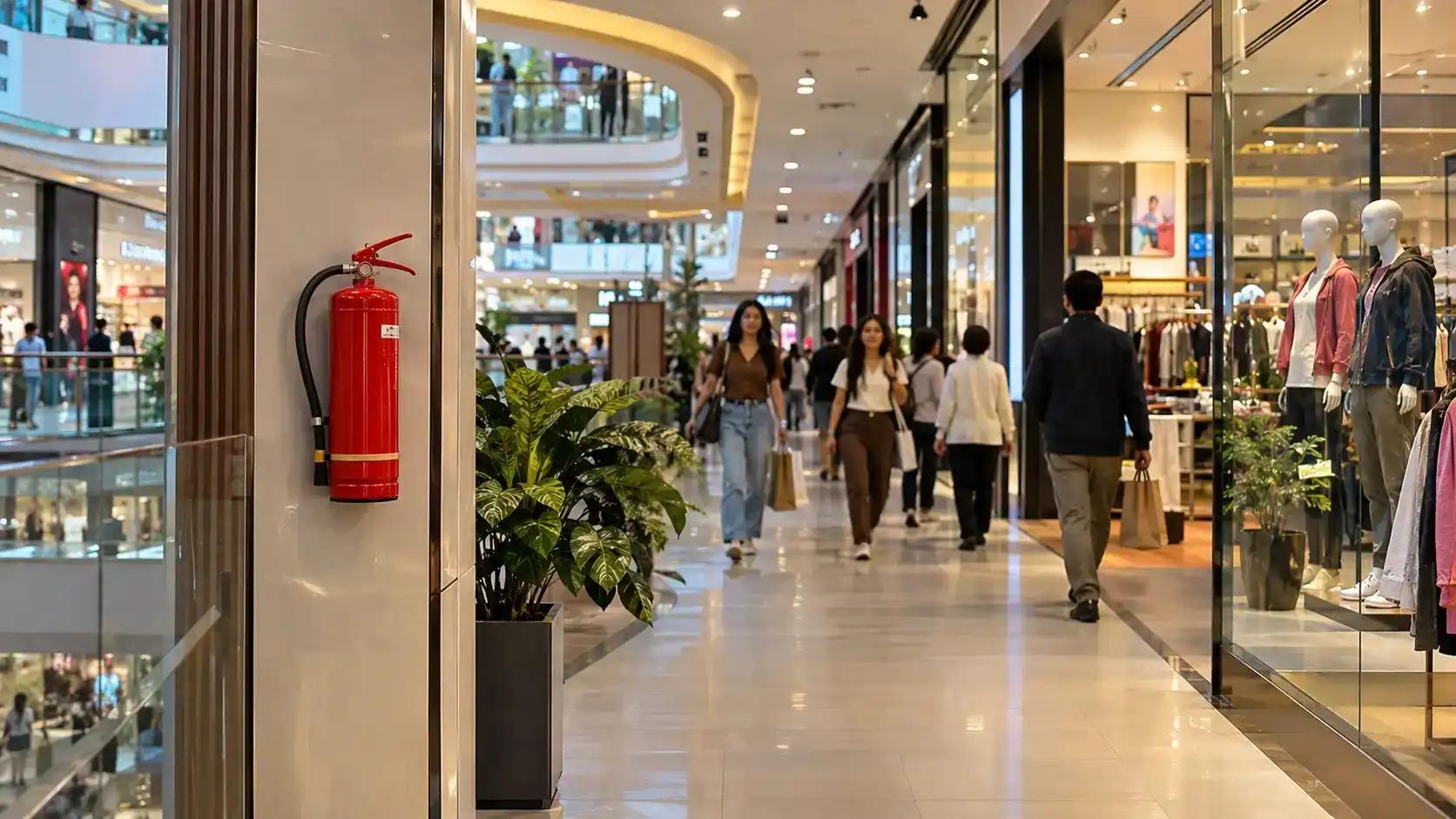
Shopping malls and retail stores require carefully planned fire protection because a single commercial property can contain many different types of fire hazards. A shopping mall may include clothing stores, electronics shops, supermarkets, restaurants, food courts, storage rooms, electrical panels, server rooms, escalators, plant rooms, parking areas and common corridors. Each zone may contain different combustible materials and ignition sources.
For this reason, selecting a fire extinguisher for a shopping mall should not mean installing the same extinguisher throughout the entire building. A proper mall fire-extinguisher plan should consider:
type of retail occupancy
materials stored or displayed
total floor area
number of floors
fire load
electrical equipment
food courts and commercial kitchens
storage and stock rooms
parking and basement areas
electrical and plant rooms
extinguisher fire rating
travel distance
evacuation routes
accessibility during an emergency
Safelinc’s current fire-extinguisher guidance similarly states that extinguisher quantity, distribution and placement should be determined according to the fire-risk assessment and applicable requirements rather than by cylinder size alone. Explore Safelincs' complete fire extinguisher range in Nepal.
Why Shopping Malls Require Zoned Fire Protection?
A shopping mall should not be treated as one uniform fire-risk area. Consider the difference between these locations:
Fashion Store → Electronics Shop → Food Court → Stock Room → Electrical Room → Parking Basement
A fashion retailer may contain large quantities of clothes, cardboard and display materials. An electronics shop may contain: computers, televisions, batteries, chargers, electrical wiring and expensive electronic equipment.
A food court introduces:
cooking oils
LPG or gas
high-temperature cooking equipment
electrical appliances
grease
An underground parking area may contain vehicles, fuel, lubricants, batteries and electrical charging equipment.
Because the hazards vary, the extinguisher type and placement should also vary. This zoned fire-protection approach is especially important in large malls where different tenants operate independently but still share common circulation routes and building fire-safety systems.
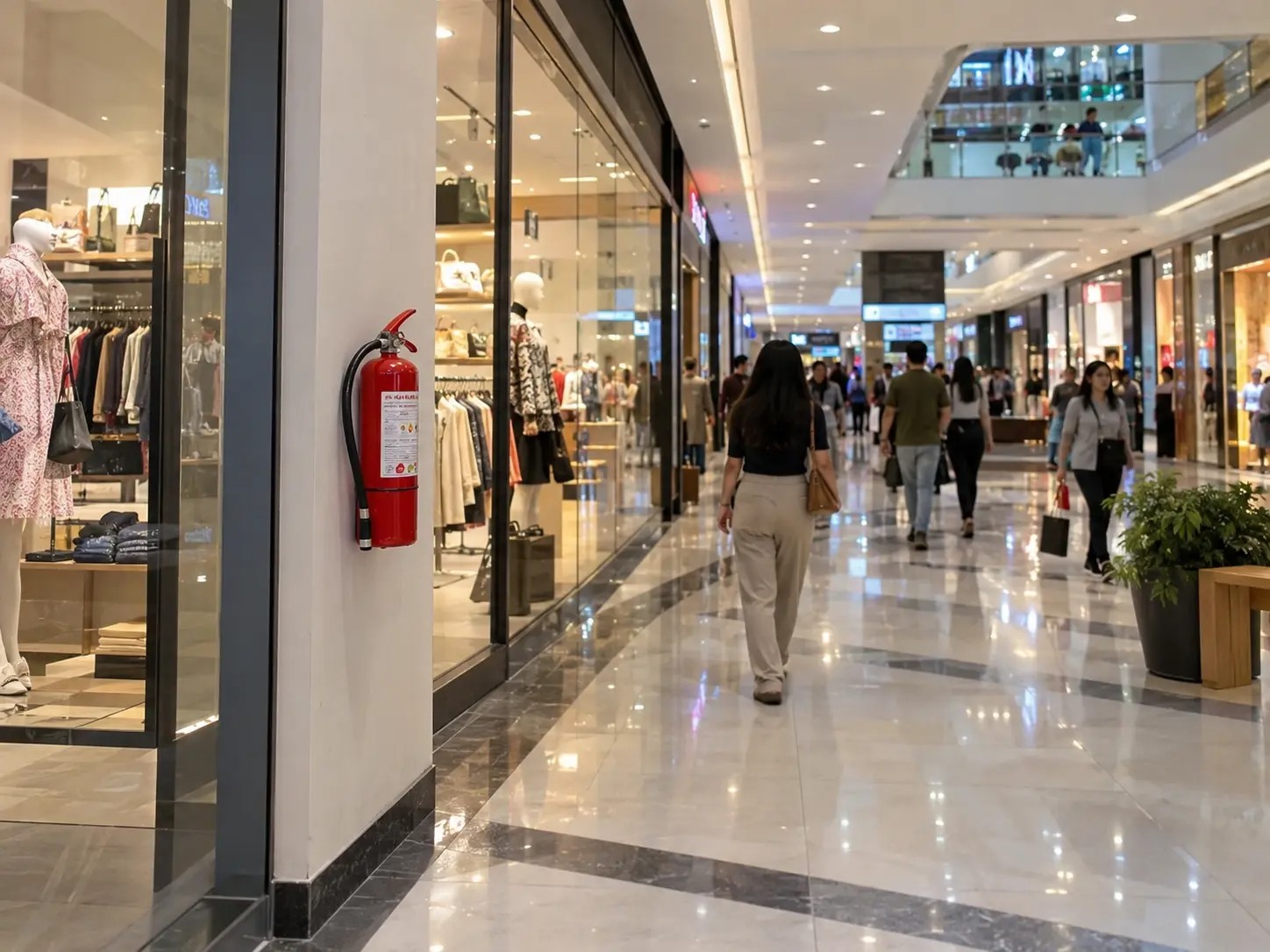
Common Fire Risks in Shopping Malls
The first step is to identify the fire hazards in each area are:
Mall Area | Typical Fire Hazards | Main Extinguisher Consideration |
Retail stores | Paper, clothing, furniture, plastics, packaging | General combustible protection |
Common corridors | Mixed general hazards | Accessible general coverage |
Electronics stores | Electrical equipment and batteries | Electrical suitability |
Food court | Cooking oil, LPG, electrical appliances | Multiple extinguisher types |
Stock rooms | Cardboard, packaging, stored merchandise | Higher combustible fire load |
Electrical rooms | Panels, cables, switchgear | Electrical protection |
Server/control rooms | Electronics, UPS, network equipment | Low-residue protection |
Plant rooms | Electrical/mechanical equipment | Hazard-specific protection |
Parking areas | Vehicles, fuel, oils and batteries | Mixed hazard assessment |
Loading/service areas | Packaging, goods and vehicles | General + specialist risks |
This is why the question should not only be: “How many fire extinguishers does a shopping mall need?”
It should be: “What extinguisher type, rating, quantity and placement does each mall zone require?”
Which Fire Extinguishers Are Needed in Shopping Malls?
Most shopping malls require more than one extinguisher type because of the variety of hazards present. Common extinguisher technologies include:
1. ABC Dry Powder Fire Extinguishers
ABC dry powder extinguishers provide multipurpose protection for several common fire hazards when appropriately rated.
They may be considered for general mall areas involving combustible materials such as: paper, cardboard, furniture, textiles, packaging, plastics and other mixed commercial hazards
This makes ABC extinguishers useful for consideration in many retail units, stock areas and common commercial spaces.
Safelincs provides various portable ABC capacities for commercial applications. Its current ABC guidance lists workplaces, commercial buildings and other larger facilities among common applications.
2. CO₂ Fire Extinguishers
CO₂ extinguishers are particularly relevant where energized electrical equipment represents a major hazard.
Typical mall applications may include: electrical rooms, switchboards, control panels, server rooms, POS equipment, electronics stores, communication equipment and some plant-room equipment.
One advantage of CO₂ is that it leaves virtually no solid residue after discharge, which can be useful around sensitive electronics.
Safelincs identifies CO₂ extinguishers for appropriate electrical and flammable-liquid hazards
3. Foam Fire Extinguishers
Foam extinguishers may be considered where suitable Class A combustible materials and applicable flammable-liquid hazards are present.
Safelincs' AFFF foam extinguishers are listed for Class A materials such as wood and fabrics and Class B flammable-liquid hazards such as petrol and diesel. The site's guidance also states that its foam extinguishers should not be used on live electrical equipment.
Their application in a shopping mall should therefore be based on the actual hazard rather than installing foam units throughout the entire property.
4. K-Type Fire Extinguishers
Food courts and mall restaurants require additional attention because high-temperature cooking oils and fats can create specialist kitchen fire hazards.
Safelincs specifically identifies K-Type extinguishers for commercial kitchens, restaurants, cafeterias and similar food-service environments.
5. Clean-Agent Fire Extinguishers
Shopping malls may also contain sensitive electronic infrastructure, such as: server rooms, network rooms, security-control rooms, communication equipment, electrical equipment rooms and data-storage areas.
Safelincs' clean-agent extinguisher range is specifically positioned for electrical equipment rooms, computer centres, communication equipment and data/document storage where residue from extinguishing agents may be undesirable.
Retail Store Fire Extinguisher Requirements
Individual retail stores within a mall should be assessed according to what they sell and store. A clothing retailer does not necessarily have the same risk as an electronics store, pharmacy or home-furnishing showroom.
1. Clothing and Fashion Stores
Common combustible materials include: clothes, fabrics, paper tags, cardboard packaging, furniture and decorative displays. An appropriately rated general-purpose extinguisher may therefore form part of the protection strategy.
2. Electronics Stores
Electronics retailers can contain: televisions, computers, chargers, electrical displays, batteries, wiring, UPS equipment and other energized devices. Electrical risk should therefore be considered separately, and CO₂ or suitable clean-agent protection may be appropriate depending on the equipment and fire-risk assessment.
3. Furniture and Home-Goods Stores
These spaces may have a comparatively high combustible fire load because of: wood, fabric, foam, plastics, packaging and large display areas. The required extinguisher rating and distribution should account for the actual combustible load and store layout.
4. Supermarkets and Department Stores
Large stores can combine several hazards: Retail Displays + Stock Rooms + Electrical Equipment + Refrigeration + Packaging + Food Preparation
They should therefore be treated as multiple fire-risk zones rather than one large retail floor.
Fire Extinguisher Protection for Mall Common Areas
Mall corridors, entrances, lobby areas and other shared spaces require coordinated protection.
Extinguishers in these locations should generally remain: visible, unobstructed, easy to identify, accessible to trained personnel, properly mounted or secured and positioned so that a developing fire does not block access.
Safelincs' current placement guidance specifically recommends visibility, accessibility, suitable mounting, protection from obstruction and location according to the identified fire hazard.
Common-area extinguishers should also be coordinated with: escape routes, staircases, emergency exits, fire-alarm devices, hydrant/hose systems and tenant spaces.
The objective is not simply to place cylinders at regular visual intervals. Each location should provide practical fire protection while preserving a safe route of escape.
Fire Protection for Food Courts
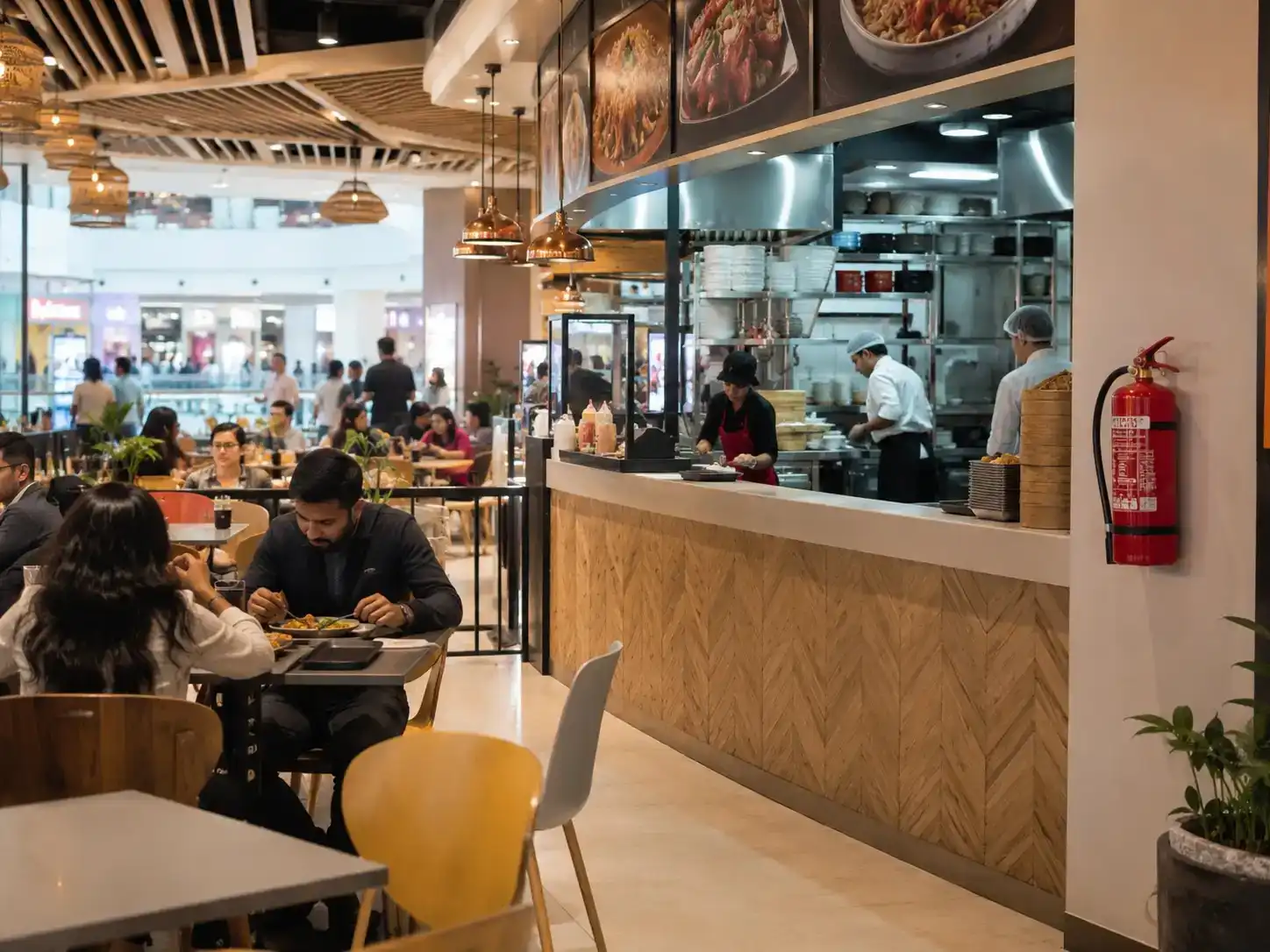
Food courts are among the higher-risk areas of a shopping mall because they can contain many independent kitchens operating close together.
Possible hazards include:
hot cooking oils
deep fryers
LPG or gas
electrical cooking equipment
ovens
grills
refrigerators
exhaust systems
grease accumulation
combustible packaging
For this reason, food-court protection should not rely only on the ABC extinguishers installed throughout the mall.
Cooking-Oil Fires
Commercial kitchens that use high-temperature cooking oils and fats should assess the need for specialist K-Type/wet-chemical extinguishers.
Safelincs' K-Type guidance specifically addresses commercial-kitchen cooking-oil and grease fires and explains that these hazards require a specialist extinguishing agent.
Electrical Appliances
Appropriately rated CO₂ protection may also be considered where energized electrical appliances and control equipment create a specific hazard.
LPG/Gas Areas
Gas installations should be assessed together with:
cylinders;
valves;
regulators;
pipelines;
ventilation; and
emergency fuel isolation.
The extinguisher should never be treated as a replacement for correct LPG installation, maintenance and emergency isolation procedures.
For more detailed planning, this article should internally link to the separate child guide:
Fire Extinguisher Requirements for Restaurants & Commercial Kitchens: Fire Risks, Selection & Placement
Fire Extinguishers for Electrical and Plant Rooms
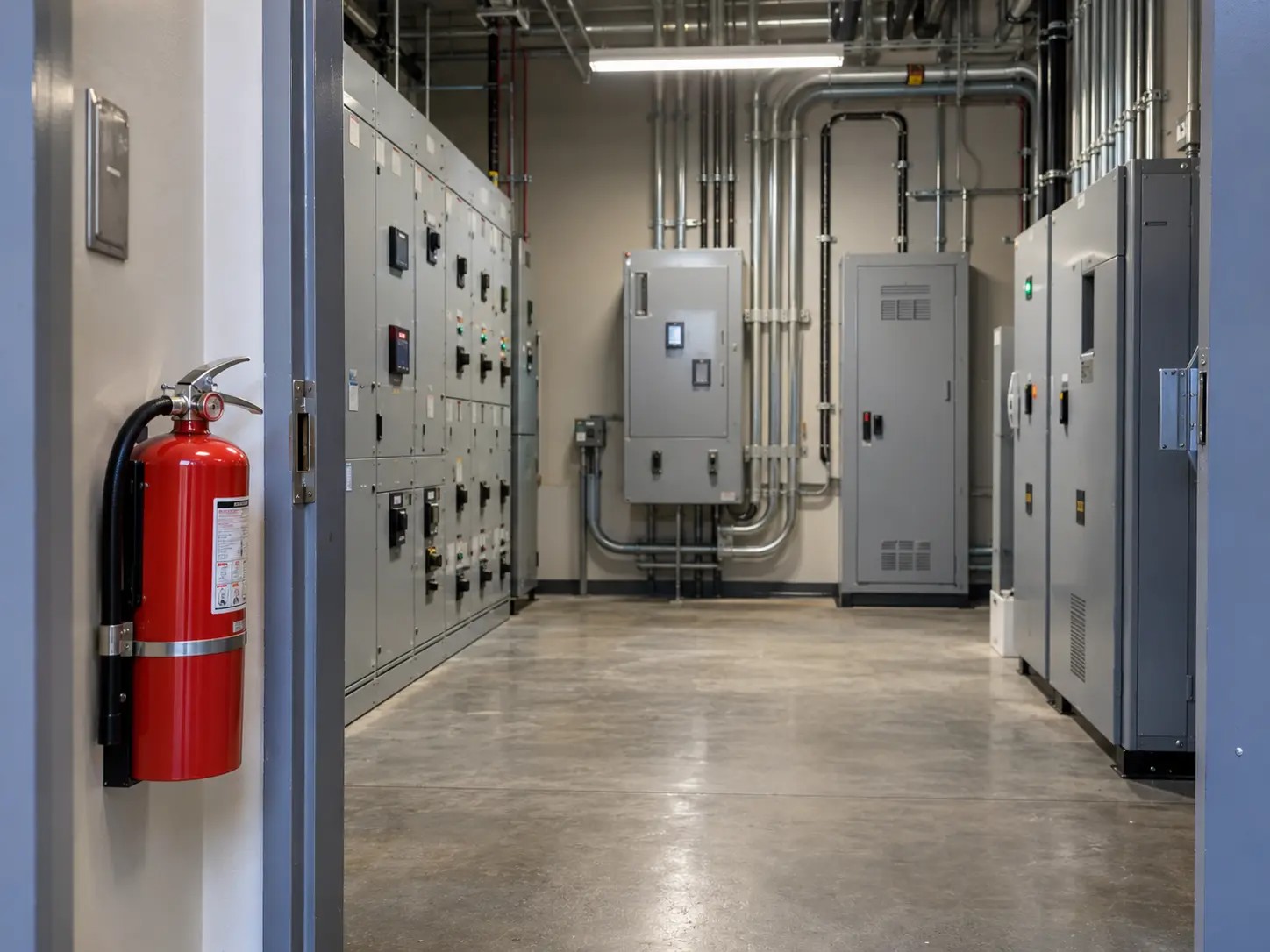
Shopping malls often contain extensive electrical infrastructure.
Possible equipment includes:
main distribution panels
transformers
switchgear
generators
UPS systems
building-management controls
elevator equipment
HVAC controls
These areas should receive a dedicated fire-risk assessment. Where appropriate, CO₂ may be considered for energized electrical hazards, while a clean-agent extinguisher may be preferred around particularly sensitive equipment where residue is a concern.
Safelincs' clean-agent product guidance specifically identifies electrical equipment rooms and computer centres among suitable applications.
Extinguishers should be located so that staff do not need to move toward the equipment fire to retrieve them. Electrical rooms should also remain free from unnecessary combustible storage.
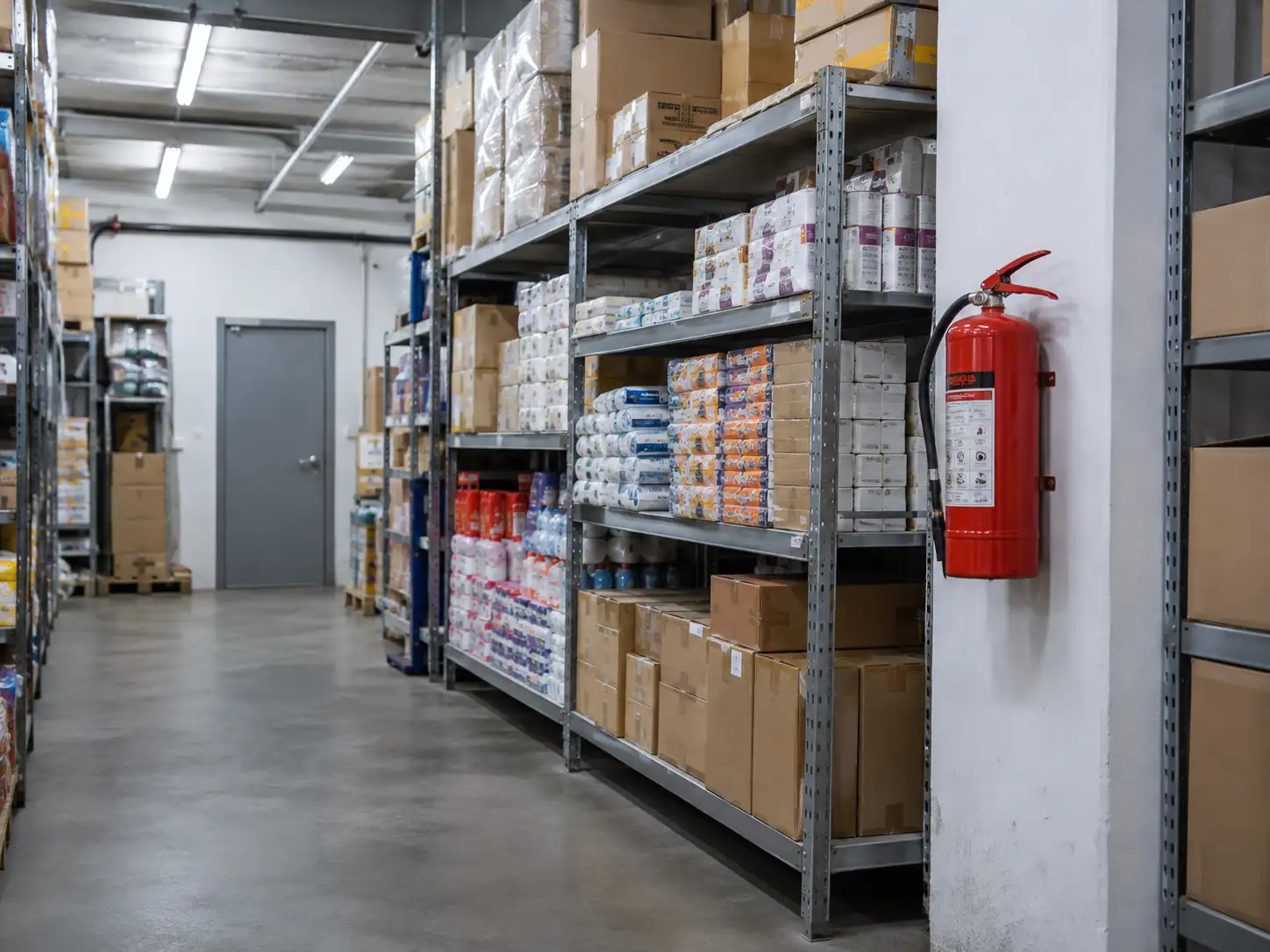
Fire Extinguishers for Stock and Storage Rooms
Retail malls can contain large quantities of stored merchandise away from customer-facing areas. Typical storage materials include:
cardboard cartons
plastic wrapping
textiles
paper
wooden pallets
merchandise
cleaning supplies
promotional materials
This can create a substantially higher fire load than the sales floor. Extinguisher planning should therefore consider:
1. Type of Stored Material
A clothing stock room and a maintenance-chemical storage area should not automatically use the same protection strategy.
2. Storage Density
Tightly packed cartons can create more severe fire conditions than small quantities of distributed stock.
3. Rack Layout
Racking can influence access, visibility and fire spread.
4. Electrical Equipment
Lighting, charging equipment and wiring can introduce ignition sources within the storage area.
5. Escape and Access Routes
Stock should never obstruct extinguishers, exits or emergency circulation routes.
Parking and Basement Areas
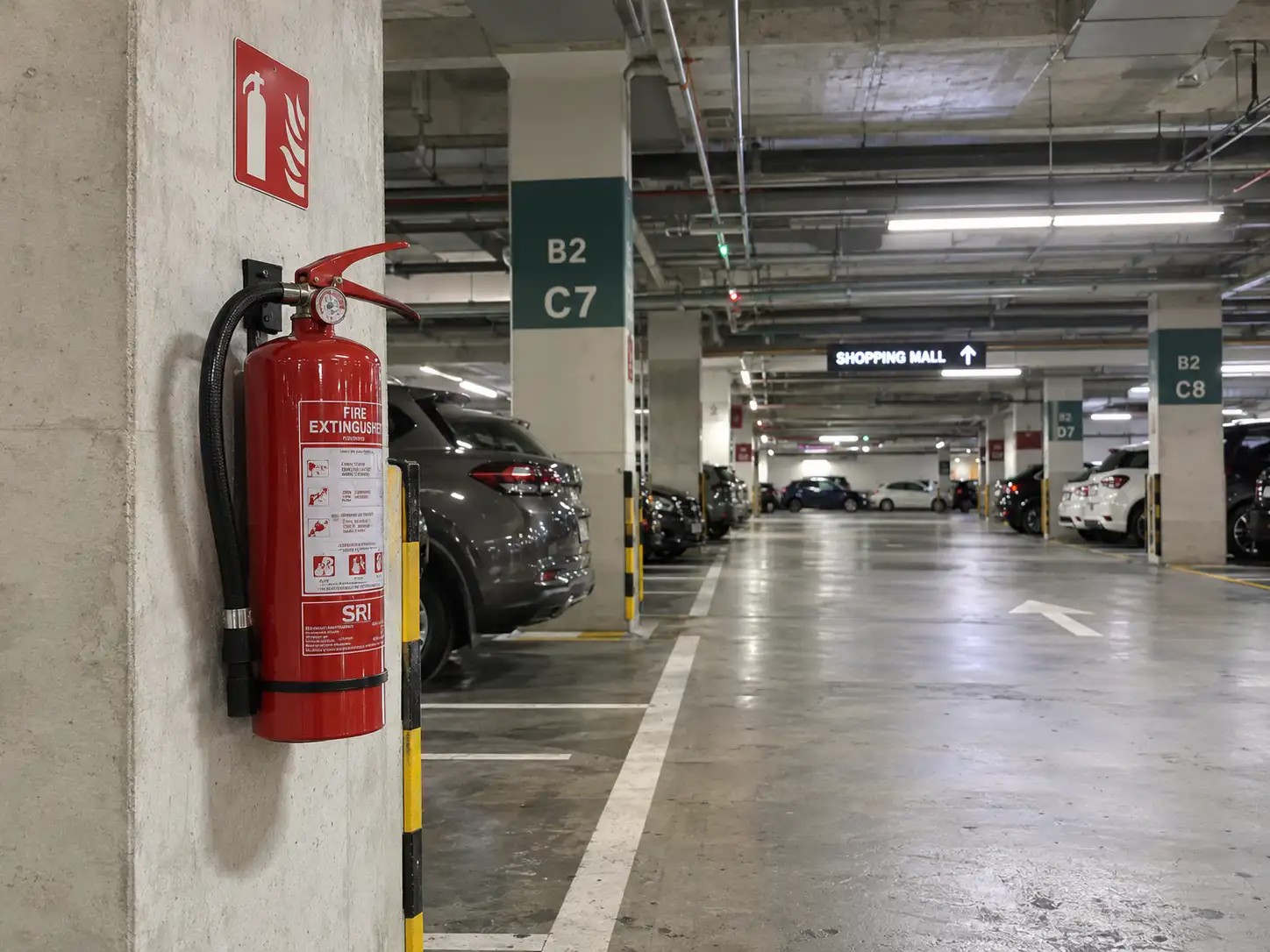
Mall parking structures may introduce different hazards from the retail floors above. Possible risks include:
petrol and diesel vehicle
lubricants
vehicle electrical systems
batteries
EV charging equipment
maintenance areas
stored materials
plant equipment
The correct extinguisher type depends on the specific hazard.
For example, foam extinguishers may be applicable to certain flammable-liquid hazards but should not be used indiscriminately around energized electrical equipment. Safelincs' foam guidance specifically identifies Class A and Class B applications while warning against use on live electrical equipment.
Where parking areas contain EV charging stations, generators or electrical systems, those risks should be assessed separately rather than assuming standard vehicle-fire coverage is sufficient.
How Many Fire Extinguishers Does a Shopping Mall Need?
There is no responsible universal statement such as: “Every shopping mall needs one extinguisher for every X shop.”
Shopping malls vary too much in floor area, layout, occupancy and hazard. The final quantity should consider several technical factors, which are as follows:
1. Total Floor Area
Large floors generally require more distributed coverage than small retail units. However, area alone is not sufficient.
2. Number of Floors
Every mall floor should be assessed individually. Equipment on the ground floor should not automatically be counted as protection for upper-level retail areas.
3. Number of Retail Units
Each shop may contain its own hazards, while common areas require separate mall-management protection.
4. Extinguisher Fire Rating
Quantity should be related to the tested firefighting capability of the extinguishers rather than cylinder weight alone. Safelincs' fire-safety content demonstrates that extinguishers of similar nominal size can have different fire ratings and technical characteristics.
5. Travel Distance
The correct extinguisher should be reachable quickly without requiring staff to pass through a developing fire.
6. High-Risk Areas
Additional dedicated protection may be needed around: food courts, restaurants, electrical rooms, server rooms, plant rooms, stock rooms, loading areas and parking facilities.
7. Mall Layout
Factors such as: long corridors, multiple wings, atriums, enclosed tenant spaces, staircases, service corridors and separate buildings can significantly change extinguisher distribution.
Better Mall Quantity Planning
Instead of using a blanket cylinder count, follow:
Site Survey → Divide Mall Into Fire-Risk Zones → Identify Fire Classes → Select Extinguisher Type → Confirm Fire Rating → Assess Floor Coverage → Check Travel Distance → Identify Special Hazards → Determine Quantity → Finalize Placement
Safelincs likewise states that the number of extinguishers, travel distance and distribution should be determined through fire-risk assessment and applicable fire-safety requirements.
Fire Extinguisher Placement and Accessibility
Correct placement is essential in a mall because crowded public spaces can become difficult to navigate during an emergency.
Extinguishers should generally be:
clearly visible
unobstructed
easily accessible
properly secured
supported by identification signage where required
positioned along logical circulation or escape routes
located according to the hazard.
Do not position extinguishers where:
merchandise blocks visibility
temporary promotional displays obstruct access
doors conceal them
stock is placed directly in front
customers can easily tamper with them
The expected fire itself is likely to prevent access
Safelincs' installation guidance specifically notes that extinguishers should not be positioned where a developing fire could prevent safe access. Mall management should include extinguisher accessibility in routine inspections because tenant displays and promotional installations can change frequently.
Shopping Malls Need More Than Portable Fire Extinguishers
A shopping mall is a large, complex public building. Portable extinguishers should therefore form only one part of an integrated fire-safety system.
A complete strategy may include: Detection → Alarm → Evacuation → Initial Suppression → Fire Control → Firefighting Response
Depending on the design, this can include: smoke detectors, heat detectors, beam detectors, addressable fire-alarm panels, manual call points, sounders and strobes, sprinkler systems, hydrant systems, hose reels, emergency lighting, fire-rated doors, smoke control, portable extinguishers and kitchen suppression systems.
Safelincs' current fire-safety range emphasizes combining detection, alarms, suppression and firefighting equipment according to occupancy, building risk and layout.
Fire Alarm Systems for Shopping Malls
Large shopping malls especially benefit from fire-alarm systems capable of identifying fire or fault locations accurately.
Safelincs notes that addressable systems can provide:
individual device identification
detailed fault location
event logging
programmable cause-and-effect
loop monitoring
integration with other building systems
Its guidance identifies addressable systems as particularly useful for medium-to-large or complex properties with multiple floors, many devices and advanced integration requirements.
This can be highly relevant in a mall where security or facility teams need to distinguish between alarms from locations such as: Food Court – Level 3 and Electrical Room – Basement 1 rather than receiving only a general building alarm.
Inspection and Maintenance
Fire extinguishers installed across malls and retail stores should be checked routinely. Facility teams should confirm:
each extinguisher remains in its designated location
access is unobstructed
identification signage remains visible
safety pin is intact
tamper seal is present
hose and nozzle are undamaged
pressure indication is normal where applicable
cylinder shows no significant corrosion or physical damage
mounting equipment remains secure
operating instructions remain readable
Mall management should also pay particular attention to tenant fit-outs and promotional displays because they can unintentionally obstruct fire-safety equipment.
Any extinguisher that has been discharged should be professionally inspected and serviced before being returned to operational use.
Staff Training and Emergency Readiness
Mall fire safety involves more than installing equipment. Appropriate personnel, including: security teams, facility staff, maintenance personnel, store managers, food-court staff and emergency-response teams should understand the mall's fire procedures.
Staff expected to operate portable extinguishers should know:
where extinguishers are located
how to raise an alarm
which extinguisher matches the hazard
when firefighting should not be attempted
how to maintain a safe escape route
when immediate evacuation is required
The basic PASS technique is:
P: Pull the pin
A: Aim at the base of the fire
S: Squeeze the handle
S: Sweep from side to side
Safelinc’s PASS-method guide also stresses checking the fire hazard and selecting the correct extinguishing agent before attempting to use an extinguisher.
Shopping Mall Fire Safety Checklist
Mall owners, facility managers and retail operators can use this checklist:
Mall divided into separate fire-risk zones
Each floor assessed individually
Retail units assessed according to merchandise
Food courts and restaurants assessed separately
Cooking-oil hazards identified
Electrical and plant rooms evaluated
Server/control rooms protected appropriately
Stock and storage areas assessed
Parking and basement hazards reviewed
Extinguisher types match the identified hazards
Fire ratings checked
Quantity considers floor area and layout
Travel distance considered
Extinguishers clearly visible
Displays and merchandise do not block extinguishers
Emergency exits remain unobstructed
Fire-alarm and detection systems are operational
Hydrant/sprinkler systems maintained where installed
Staff receive emergency-response training
Extinguishers are inspected and serviced
Tenant fit-outs do not compromise fire-safety equipment
Choosing Fire Extinguishers for Shopping Malls & Retail Stores in Nepal
The most important principle is to avoid treating the entire mall as one fire hazard. A shopping mall can contain: Retail Combustibles + Electrical Equipment + Cooking Oils + LPG + Flammable Liquids + Storage + Vehicles + Sensitive Electronics
The extinguisher strategy may therefore include:
ABC Dry Powder: general retail and mixed combustible hazards
CO₂: appropriate energized electrical equipment
Foam: suitable Class A and flammable-liquid applications
K-Type/Wet Chemical: commercial cooking oils and fats
Clean Agent: sensitive electronic and control equipment
The exact combination, fire rating, quantity and placement should be finalized after assessing the actual property. For large malls, portable extinguishers should also be coordinated with fire detection, alarm, hydrant, sprinkler, evacuation and passive fire-protection systems rather than treated as standalone protection.
Safelincs Technologies supplies fire extinguishers in Nepal together with broader fire safety equipment for retail, commercial and institutional properties.
Frequently Asked Questions
1. Which fire extinguisher is best for a shopping mall?
There is no single extinguisher suitable for every mall area. ABC units may cover many general hazards, while electrical rooms, food courts and sensitive equipment areas can require CO₂, K-Type or clean-agent protection.
2. How many fire extinguishers does a shopping mall need?
The quantity depends on floor area, number of floors, extinguisher fire rating, travel distance, retail hazards, food courts, electrical rooms and building layout. A site-specific fire-risk assessment should determine the final quantity and distribution.
3. Which fire extinguisher should be used in retail stores?
It depends on what the store sells and the hazards present. General retail combustibles may use an appropriately rated general-purpose extinguisher, while electronics shops or specialist stores may require additional protection.
4. What fire extinguisher is needed for a mall food court?
Food courts should be assessed for cooking oil, LPG, electrical and general combustible hazards. Commercial cooking areas using high-temperature oils may require K-Type/wet-chemical protection.
5. Which extinguisher should be used in an electrical room of a mall?
CO₂ or other appropriately rated electrical-fire protection may be suitable depending on the equipment and risk assessment. Sensitive electronic areas may also be candidates for suitable clean-agent extinguishers.
6. Can foam extinguishers be used in parking areas?
Foam may be appropriate for certain Class A and flammable-liquid hazards, but the specific fire risk must be assessed. Safelincs' foam products should not be used on live electrical equipment.
7. Where should fire extinguishers be placed in a shopping mall?
They should be visible, unobstructed and safely accessible along appropriate circulation or escape routes and near identified higher-risk zones. They should not be positioned where the developing fire could block access.
8. Do individual retail stores need their own fire extinguishers if the mall has extinguishers in the corridor?
Each retail unit should be assessed according to its size, layout, merchandise and hazards. Corridor extinguishers should not automatically be assumed to provide sufficient protection for every tenant space.
9. Are portable extinguishers enough for shopping mall fire safety?
No. Large malls normally require an integrated strategy involving detection, alarms, evacuation provisions and other active or passive fire-protection systems according to the building design and applicable requirements.