
Fire Extinguisher Requirements for Schools & Colleges in Nepal: Types, Quantity & Placement
Explore fire extinguisher requirements for schools and colleges in Nepal, including suitable types, quantity, and placement for classrooms, laboratories, computer rooms, and canteens to improve campus fire safety.
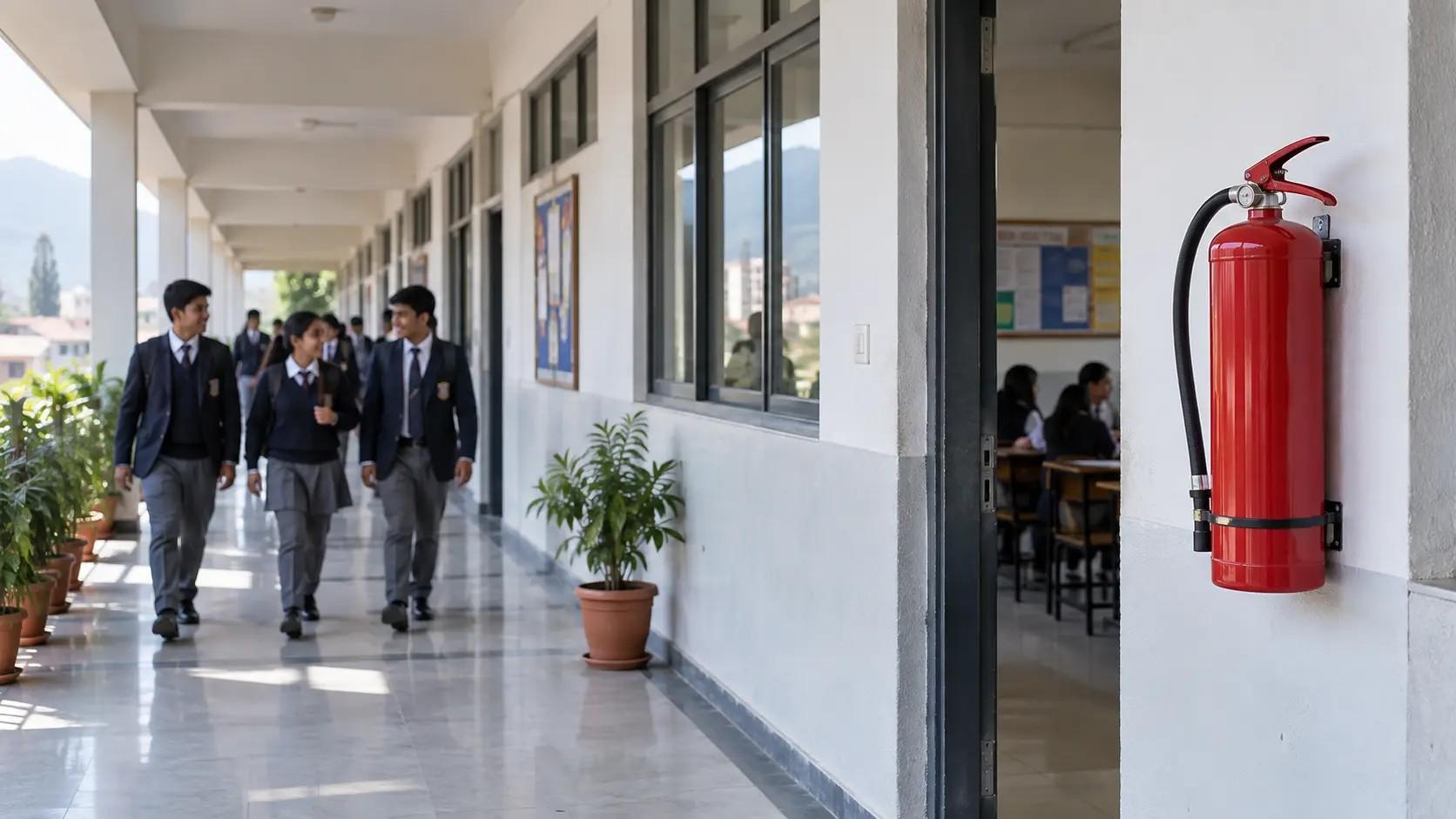
Schools and colleges present a different fire-safety challenge from ordinary commercial buildings. A single educational campus may contain classrooms filled with paper and furniture, computer laboratories with sensitive electronic equipment, science laboratories containing chemicals and electrical apparatus, libraries with a high combustible load, kitchens using cooking oils and LPG, and electrical or utility rooms.
Because these areas do not present the same fire hazard, selecting a fire extinguisher for a school should not be based on a single extinguisher type or cylinder size.
A proper school fire-safety plan should consider:
the type of material that could burn;
number and size of buildings;
number of floors;
fire rating of the extinguishers;
travel distance to an extinguisher;
laboratories and other higher-risk areas;
electrical and electronic equipment;
kitchens and canteens;
evacuation routes; and
accessibility during an emergency.
Schools and colleges in Nepal should therefore plan fire extinguishers as part of a wider fire safety equipment system rather than treating individual cylinders as the complete fire-protection solution.
Why Schools Need Premises-Specific Fire Protection
The main fire hazard in a normal classroom is very different from the hazard inside a chemistry laboratory or computer room.
For example, a classroom may primarily contain combustible materials such as:
books
paper
wooden desks
curtains
notice boards
school bags and
plastic furniture
A computer laboratory adds energized electrical equipment, UPS systems, wiring and networking devices. A science laboratory can introduce chemicals, heating equipment, electrical apparatus and experimental materials. A school canteen may introduce LPG, cooking appliances, hot oil and grease.
That means a single extinguisher specification should not automatically be repeated throughout the entire campus.
Nepal's school-building design guidelines recognize this distinction. The government's school-design guidance identifies laboratories as potentially dangerous spaces and calls for safety equipment including a fire extinguisher, fire blanket, eye and face spray, first-aid kit and neutralizing solutions to be readily accessible. The same guideline references Nepal's NBC 107 fire-safety provisions as part of the standards considered in school design. A stronger school fire-protection strategy therefore starts with hazard zoning.
Common Fire Risks in Schools and Colleges
A school fire-risk assessment should examine each part of the premises separately.
School area | Typical fire risk | Main extinguisher consideration |
Classrooms | Paper, books, furniture, plastics | General combustible-material protection |
Library | Large quantities of paper and books | Higher combustible fire load |
Computer lab | PCs, monitors, UPS, networking equipment | Electrical suitability and residue |
Science laboratory | Chemicals, electrical equipment, burners and experiments | Hazard-specific extinguisher selection |
Kitchen/canteen | Cooking oils, LPG and electrical appliances | Cooking-oil and kitchen-specific protection |
Electrical room | Distribution panels, breakers and wiring | Electrically suitable extinguisher |
Administration | Paper, electronics and furniture | General + electrical hazards |
Store room | Paper, furniture, cleaning materials or supplies | Stored-material fire load |
Corridors | General building coverage | Visibility and accessibility |
Auditorium | Electrical systems, furnishings and high occupancy | Coverage plus evacuation planning |
Which Fire Extinguisher Is Best for a School?
There is no single extinguisher that is automatically best for every part of a school. Several types may be appropriate depending on the identified hazard.
1. ABC Dry Powder Fire Extinguishers
ABC dry powder extinguishers are commonly used as multipurpose extinguishers and can provide broad protection against several common fire hazards depending on their certified fire rating.
Within a school, they may be considered for general areas where mixed fire hazards are present.
Before selecting one, check:
extinguishing agent
certified fire rating
capacity
working pressure
applicable certification
discharge characteristics
intended application
Safelincs currently supplies ABC extinguishers in multiple portable capacities.
2. CO₂ Fire Extinguishers
CO₂ extinguishers can be useful where electrical and electronic equipment represents an important fire risk.
Because CO₂ leaves no powder residue after discharge, it may be considered for locations containing equipment such as:
computers
servers
electrical panels
UPS systems
laboratory electronics
communication equipment
However, extinguisher selection must still follow the actual product rating and the identified fire hazard.
3. Clean-Agent Fire Extinguishers
For high-value or sensitive electronic equipment, a clean-agent extinguisher may also be considered where the individual product's fire rating and application are appropriate.
Safelincs' clean-agent category lists applications including computer centres, laboratories, electrical equipment rooms and data/document storage areas.
4. K-Type / Wet-Chemical Fire Extinguishers
Schools and colleges operating larger kitchens or canteens need to assess cooking-oil and cooking-fat hazards separately.
A specialist K-Type extinguisher is intended for high-temperature cooking-oil and fat fires and may therefore be appropriate in commercial-style school kitchens.The exact extinguisher should always be selected according to its certified rating, manufacturer instructions and site fire-risk assessment.
Fire Extinguishers for Classrooms
Normal classrooms usually contain significant quantities of ordinary combustible materials.
Typical examples include:
books and notebooks
wooden or composite furniture
paper displays
curtains
cardboard
educational materials
plastic items
General-purpose protection may therefore form the basis of classroom fire-extinguisher planning.
However, simply placing one extinguisher inside every classroom without considering the overall layout is not an adequate design method.
The school should examine:
Floor coverage: How much area must be protected?
Travel distance: Can staff reach an extinguisher quickly without travelling through the developing fire?
Escape routes: Is the extinguisher positioned so the user retains a safe route of escape?
Fire rating: Does the extinguisher provide sufficient tested firefighting capability?
Floor arrangement: Are classrooms spread along multiple corridors, wings or separate blocks?
In many layouts, appropriately positioned extinguishers serving classroom areas and circulation routes can form part of a more systematic design.
Fire Extinguishers for Science Laboratories
Science laboratories deserve separate attention because the fire hazard can be significantly more complex than in an ordinary classroom.
Nepal's school-building design guidelines specifically describe laboratories—particularly chemistry laboratories—as potentially dangerous areas. The guidance lists easily accessible fire extinguishers and fire blankets among the safety provisions for these spaces.
Possible laboratory hazards include:
combustible materials
flammable liquids
laboratory chemicals
gas burners
electrical equipment
heating devices
experiments involving ignition sources
For this reason, laboratory extinguisher selection should begin with an inventory of the substances and equipment actually present.
An ABC extinguisher may be appropriate for some hazards, while CO₂ or a clean-agent unit may be considered for suitable electrical or sensitive-equipment risks. Specialist hazards may require a different extinguishing agent altogether.
The key principle is: Do not select the laboratory extinguisher simply because the same model is installed in the classrooms.

Fire Extinguishers for Computer Labs and Electrical Rooms
Computer laboratories combine high-value electronics with electrical wiring, power supplies, UPS systems and sometimes networking or server equipment. Nepal's CEHRD Grade 10 Computer Science material explicitly advises installing fire extinguishers in the computer room so a fire can be controlled quickly and damage minimized. It also identifies dust buildup, overheating and electrical-system problems as relevant hardware/fire concerns.
For these areas, the school should consider extinguishers that are suitable for the electrical hazard while minimizing secondary damage to sensitive equipment.
CO₂ may be considered because it provides residue-free discharge for appropriate applications. Clean-agent extinguishers may also be considered where sensitive equipment needs additional protection.
For a dedicated electrical-panel room, server room or UPS room, the extinguisher should be positioned so a person does not need to move toward the source of the fire to retrieve it.

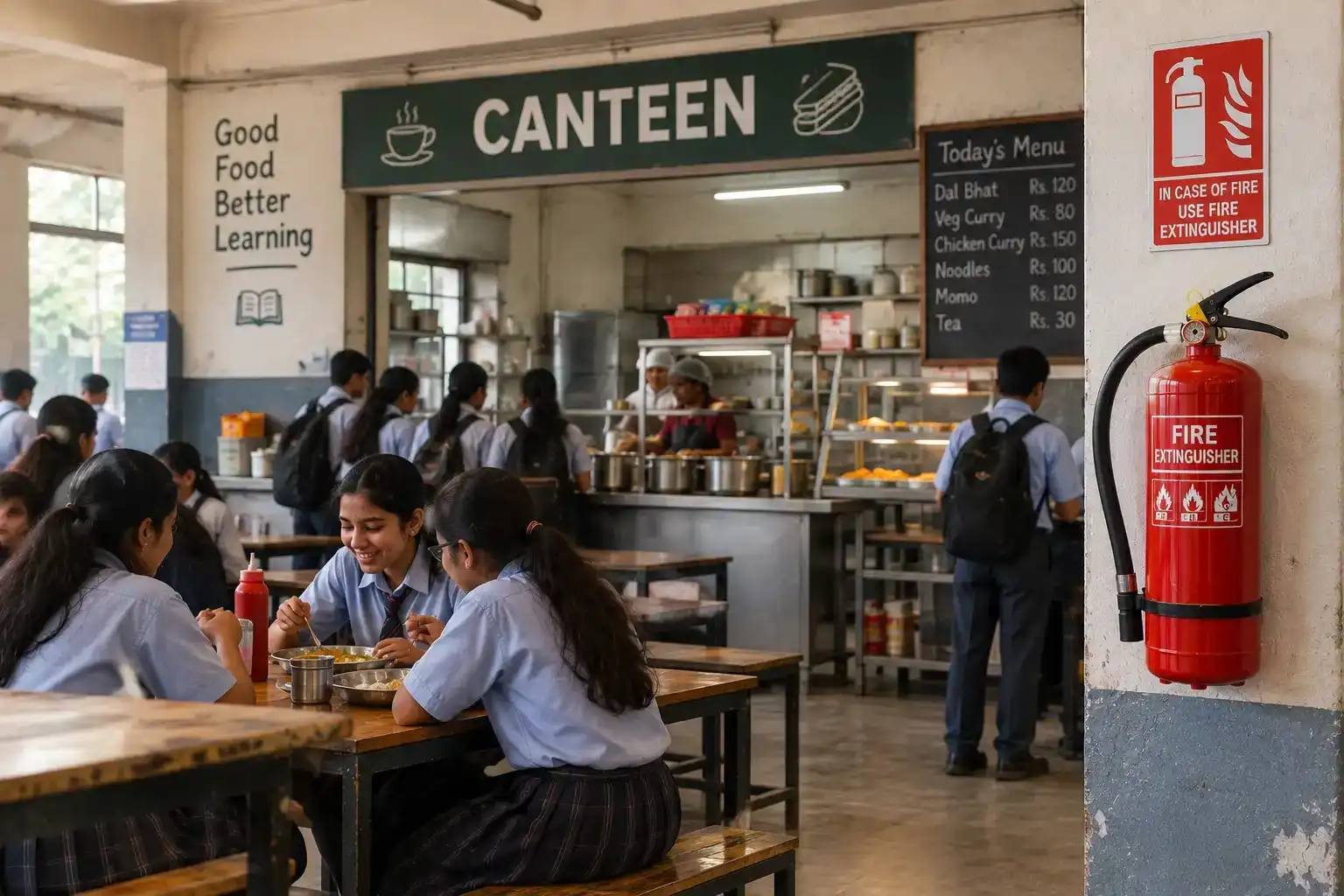
Fire Protection for School Kitchens and Canteens
A school kitchen can contain several different fire hazards at once:
Ordinary combustibles: packaging, paper and other materials.
Electrical hazards: ovens, refrigerators, mixers and electrical wiring.
LPG or gas systems: where gas is used as cooking fuel.
Cooking oils and fats: particularly where deep frying is performed.
Cooking-oil fires require particular care. Water must not be treated as a universal firefighting solution for burning cooking oil.
Where a school operates a commercial-style kitchen with significant quantities of hot cooking oil, a specialist K-Type/wet-chemical extinguisher should be considered according to the equipment and applicable fire-safety requirements.
Kitchen protection should also address:
LPG cylinder positioning
gas isolation
electrical condition
extraction systems
grease accumulation
safe cooking practices
staff emergency training
How Many Fire Extinguishers Does a School Need?
There is no reliable universal statement such as “every school needs one extinguisher for every X classrooms” that can be applied to every school in Nepal without considering the building and its hazards.
The required quantity should instead be calculated from several factors.
1. Total Floor Area
A small single-storey school and a multi-block college campus cannot reasonably have the same extinguisher quantity. Larger floor areas generally require additional extinguishers to maintain effective coverage.
2. Number of Floors
Each floor should be assessed independently. Extinguishers located on another floor should not be treated as adequate coverage simply because they are located in the same building.
3. Fire Rating of the Extinguisher
Cylinder size alone does not indicate firefighting capability. Two extinguishers of similar capacity can have different tested fire ratings. Safelincs' fire-extinguisher guidance therefore recommends considering rating, fire load, area, installation position and travel distance rather than selecting solely by cylinder weight.
4. Travel Distance
An extinguisher is only useful when it can be reached quickly and safely. The layout should therefore be assessed to determine how far occupants must travel to reach an appropriate extinguisher.
5. Hazard Level
Higher-risk rooms may require dedicated extinguishers even when general corridor coverage exists. Some high risk rooms include:
science laboratories
kitchens
computer laboratories
server rooms
electrical rooms
workshops
generator or utility areas
6. Separate Buildings or Blocks
Schools with several academic blocks should assess each building separately. An extinguisher located in the administration block should not be counted as practical protection for a laboratory block located elsewhere on campus.
7. Building Layout and Escape Routes
Long corridors, staircases, locked sections, separate wings and complex layouts can increase the quantity needed even where total floor area is relatively modest.
A Better Way to Calculate School Requirements
Instead of using a fixed “number of extinguishers per school,” follow this sequence:
Building Survey → Hazard Identification → Fire Classification → Required Fire Rating → Floor Coverage → Travel Distance → High-Risk Zones → Extinguisher Quantity → Placement
This approach produces a far more defensible and useful school fire-safety plan.
Where Should Fire Extinguishers Be Placed in Schools?
Good placement is as important as selecting the correct extinguisher. Extinguishers should generally be:
clearly visible
easy for trained staff to access
unobstructed
properly mounted or secured
supported by identification signage where required
positioned along logical circulation or escape routes
available near identified higher-risk areas
located so fire does not block access to the extinguisher
Safelinc’s technical guidance also notes that extinguishers should not be placed where the developing fire itself may prevent safe access.
Typical School Placement Zones
A school may need extinguisher coverage around:
Academic areas
classroom corridors
staircases
floor exits
common areas
Specialist areas
science laboratories
computer laboratories
libraries
workshops
electrical rooms
server/network rooms
Service areas
kitchens and canteens
stores
generator areas
utility rooms
The final location and mounting arrangement should follow the applicable project requirements and site-specific fire-safety assessment.
Fire Extinguishers Are Only One Part of School Fire Safety
Portable extinguishers are designed for small, early-stage fires. They should not be considered a replacement for fire detection, alarm and evacuation systems.
A more complete school fire-protection strategy may include: Detection → Alarm → Evacuation → Initial Suppression → Firefighting Response
Depending on the school building, this can involve:
smoke detectors
heat detectors
manual call points
fire alarm panels
sounders and strobes
fire extinguishers
hydrant or hose systems
emergency exits
fire-rated doors
Safelincs supplies conventional and addressable fire-alarm equipment, including detectors, manual call points and notification devices for school and commercial applications.
For smaller standalone detection applications, Safelincs also has battery-operated smoke detectors.
Inspection, Training and Maintenance
Installing a fire extinguisher is only the first step. A school should maintain a routine inspection and maintenance program.
1. Routine Visual Checks
Check whether:
the extinguisher is present
access is unobstructed
the safety pin is intact
the tamper seal is present
the hose and nozzle are undamaged
there is no visible corrosion or leakage
the pressure indication is normal where applicable
operating instructions remain legible
the mounting bracket or stand is secure
Any extinguisher that has been discharged, even partially, should be professionally inspected and returned to service before being relied on again. Professional inspection, servicing, refilling and pressure testing should follow the manufacturer's instructions and applicable requirements.
2. Staff Training
Teachers, laboratory staff, security personnel, administration staff and kitchen workers should know:
where extinguishers are located;
how to raise the fire alarm;
which extinguisher is appropriate for which hazard;
when attempting firefighting is unsafe;
how to maintain an escape route; and
when immediate evacuation should take priority.
Schools can also train appropriate staff in the PASS operating method:
P: Pull the pin
A: Aim at the base of the fire
S: Squeeze the operating handle
S: Sweep across the base of the fire
Students should follow the school's emergency and evacuation procedures rather than being expected to fight a fire.
School Fire Safety Checklist
School administrators and facility managers can use this quick checklist:
Fire hazards identified for every block and floor
Classrooms assessed for combustible fire load
Science laboratories assessed separately
Computer laboratories provided with appropriate protection
Electrical rooms and panels assessed
Kitchens and canteens assessed for cooking-oil and LPG hazards
Extinguisher fire ratings checked
Correct extinguisher type provided for each hazard
Quantity based on area, layout, floors and travel distance
Extinguishers visible and unobstructed
Escape routes kept clear
Fire-alarm/detection equipment checked
Extinguishers routinely inspected
Servicing and refilling records maintained
Staff receive fire-safety training
Evacuation drills conducted periodically
Emergency contacts and response procedures clearly established
Choosing Fire Extinguishers for Your School or College in Nepal
The most important principle in school fire safety is to avoid treating the entire campus as a single fire-risk zone.
Classrooms, libraries, laboratories, computer rooms, kitchens and electrical rooms contain different fuels and equipment. As a result, they may require different extinguisher technologies, fire ratings and placement strategies.
Before purchasing, assess: Fire Hazard + Fire Rating + Capacity + Building Area + Travel Distance + High-Risk Rooms + Number of Floors + Accessibility
Safelincs Technologies supplies ABC, CO₂, foam, K-Type and clean-agent fire extinguishers along with fire alarms, detectors and other fire-safety equipment for educational, commercial and institutional properties in Nepal.
For a school or college project, the extinguisher specification and quantity should be finalized after evaluating the actual site layout and fire hazards rather than purchasing identical extinguishers for every room.
Frequently Asked Questions
1. Which fire extinguisher is best for schools?
There is no single extinguisher suitable for every school area. ABC extinguishers may provide general multipurpose protection, while computer rooms, laboratories and kitchens may require CO₂, clean-agent or specialist kitchen extinguishers depending on the hazard.
2. How many fire extinguishers are required in a school?
The number depends on floor area, number of floors, extinguisher fire rating, travel distance, building layout and higher-risk rooms. A fire-risk assessment should therefore determine the quantity instead of using one fixed number for every school.
3. Which fire extinguisher should be used in a school computer lab?
An extinguisher appropriate for energized electrical and electronic equipment should be considered. CO₂ or an appropriately rated clean-agent extinguisher may be suitable depending on the specific equipment and product rating.
4. Do science laboratories need separate fire extinguishers?
Science laboratories should be assessed separately because chemicals, electrical equipment and experiments can create different hazards from ordinary classrooms. Nepal's school-building design guidance specifically includes readily accessible fire extinguishers among laboratory safety provisions.
5. Where should fire extinguishers be placed in a school?
They should be clearly visible, unobstructed and positioned where trained staff can reach them safely, including appropriate locations along circulation routes and near higher-risk areas.
6. Does a school kitchen need a different fire extinguisher?
It can. Where high-temperature cooking oils and fats are used, a specialist K-Type/wet-chemical extinguisher should be considered in addition to protection for the kitchen's other hazards.
7. Are fire extinguishers enough for school fire safety?
No. Extinguishers should form part of a broader strategy including early detection, fire alarms, evacuation routes, emergency procedures, staff training and other required fire-protection systems.